Loading community...
Why comparing Frontier Models vs Local AI models are subjective and almost irrelavant

Learning Thoughts — The Future of AI Is Bigger Than the Model
By Ctaxnagomi
Founder, Researcher & Developer — DeckerGUI Project
One thing I have learned while developing DeckerGUI is that comparing a local AI model directly against a frontier model is often a subjective exercise.
For me, the question is not simply:
“Which model is smarter?”
The more interesting question is:
“What is the model being used for, who controls it, and what does the user actually need?”
The local LLM I use may be specifically optimized for coding, local execution, experimentation, and guardrails. Most importantly, I can own and control my code, infrastructure, runtime, and deployment environment.
Comparing that directly with a frontier model developed by companies such as OpenAI or xAI is therefore somewhat like comparing a Yamaha 100 that you bought with your own money against a Shelby GT-R that you are driving on a loan. 😂
Jokes aside, they serve different purposes.
A frontier model may provide substantially greater capability, scale, and general intelligence.
A local model provides something different:
Control. Portability. Privacy. Customization. Predictable availability. Ownership.
That distinction is important to the DeckerGUI architecture.
DeckerGUI is designed around multiple operational modes: Cloud, Local, and Enterprise, rather than assuming every computation must happen inside a centralized cloud environment.
Its architecture explicitly explores offline AI inference on local GPU nodes, alongside routing between different execution environments.
Ownership Changes the Equation
I think one of the most underestimated aspects of AI development is ownership.
When you control the code, configuration, runtime environment, model deployment, hardware, and data boundaries, you gain a different form of technological independence.
That does not automatically make a local model better.
It makes the system more controllable.
For certain applications, particularly coding, private workloads, experimentation, offline inference, edge systems, and enterprise-controlled environments, that control can be more valuable than simply maximizing benchmark intelligence.
This is also why I believe local AI and frontier AI should not necessarily be viewed as competing categories.
They can become complementary layers.
A system could use:
-
A small local model for routine operations
-
A specialized model for coding
-
An enterprise model for controlled workloads
-
A frontier model when substantially greater reasoning or computation is required
That is much closer to how I envision DeckerGUI.
The future may not be:
Local vs Cloud.
It may be:
Local + Cloud + Enterprise + Edge + Specialized AI, orchestrated as one system.
The Harness May Become More Important Than the Model
DeepSeek is particularly interesting to me because of its approach to open-source tooling and the broader development surrounding models, agents, and execution systems.
If AI companies increasingly publish not only models but also agent harnesses, orchestration systems, tool-use frameworks, memory architectures, and execution environments, developers may begin adapting their software ecosystems around those environments.
That could create an interesting form of ecosystem gravity.
If a developer becomes accustomed to a particular agent harness, tool protocol, memory architecture, or swarm framework, changing the underlying model may eventually become less significant than changing the entire surrounding execution ecosystem.
I expect this could become an important direction for OpenAI and other frontier-model companies as well.
The next major competition may therefore not simply be:
Model A vs Model B.
It may become:
Agent Ecosystem A vs Agent Ecosystem B.
The model becomes one component inside a much larger computational system.
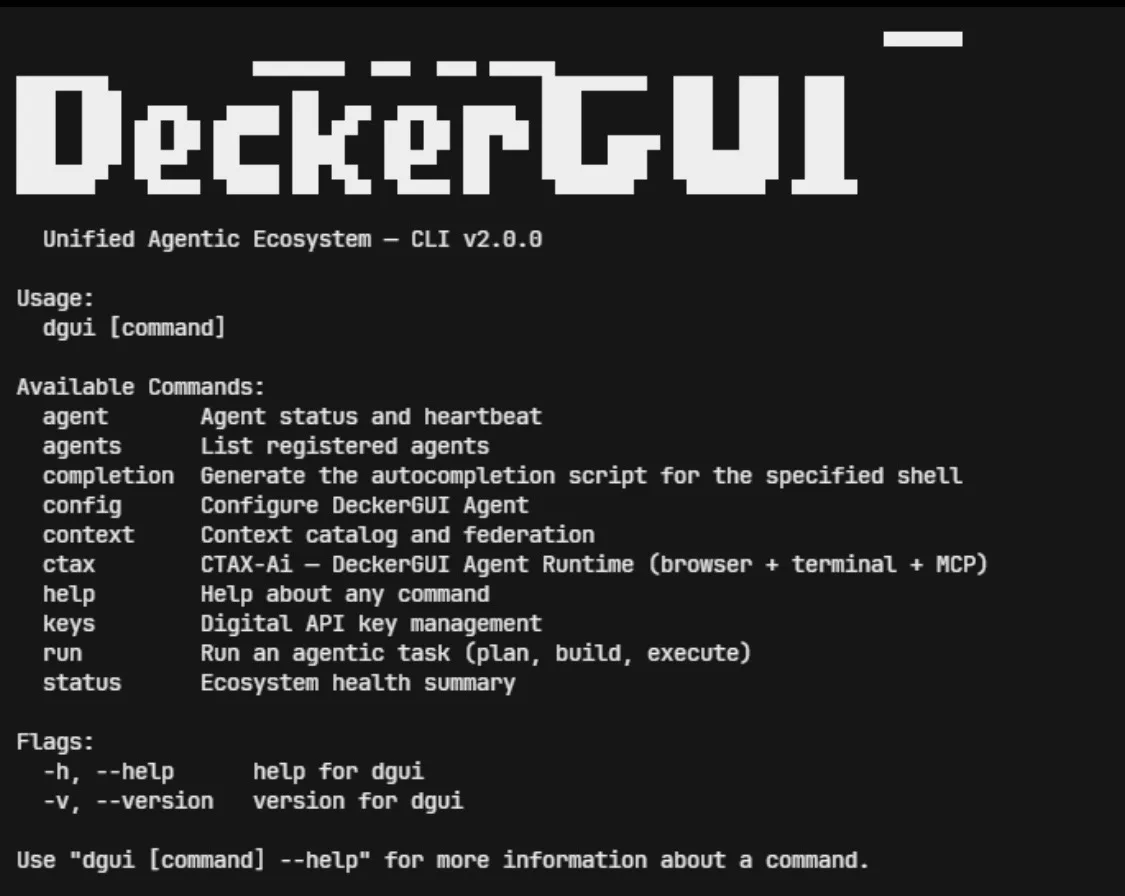
That idea aligns closely with the DeckerGUI philosophy of treating AI as a governed execution ecosystem, rather than simply an API endpoint.
DGUI Market, for example, is designed around Agentic Containers containing primary and specialized sub-agents operating under governance, approved tools, skills, and execution policies.
The model is important.
But the system around the model determines what that intelligence can actually do.
Compute Is Not the Only Bottleneck
There is another issue I think deserves substantially more attention:
Energy.
For years, AI infrastructure discussions have focused heavily on GPUs, accelerators, memory, model size, and compute availability.
But compute cannot be separated indefinitely from the physical infrastructure required to operate it.
If the industry continues pushing toward increasingly capable AI systems, and eventually AGI or ASI-scale infrastructure, we could see enormous computational workloads operating continuously.
That means enormous requirements for:
-
Electricity
-
Cooling
-
Thermal management
-
Physical infrastructure
-
Semiconductor supply
-
Networking
-
Storage
-
Energy efficiency
-
Energy generation and distribution
At some point, the question is no longer simply:
“How many GPUs can we install?”
It becomes:
“Can we physically power and cool the intelligence we are trying to build?”
That is an infrastructure question.
And infrastructure questions tend to become economic questions.
The Data Centre Should Not Just Produce Heat
This leads to an architectural idea that I find particularly interesting.
The traditional conceptual pipeline looks something like:
Generate electricity → power GPUs → produce heat → remove heat → discard it.
I don’t think that model should remain the long-term endpoint.
Future data centres could increasingly be designed around energy recovery.
Nuclear power and next-generation geothermal systems could potentially provide reliable electricity for AI infrastructure, while liquid-cooled data centres could recover thermal energy and redirect it toward useful applications.
For example:
AI Data Centre
→ Compute
→ Liquid Cooling
→ Thermal Recovery
→ District Heating
→ Industrial Processes
→ Nearby Communities
The data centre becomes not merely a consumer of energy, but part of a larger energy ecosystem.
This is particularly interesting because the waste product of computation, heat, does not necessarily have to be treated purely as waste.
It can potentially become another resource.
Could Energy Become the New Currency?
When I say “energy could become the new currency,” I don’t mean electricity will literally replace money.
I mean that access to useful, reliable, affordable energy could increasingly become one of the most important forms of economic leverage in an AI-driven economy.
Consider the chain:
Electricity → Compute → Intelligence → Heat
If we can recover that heat:
Heat → Industrial Utility → Community Infrastructure
Suddenly, energy is participating in multiple stages of the AI economy.
The valuable resource is therefore not only compute.
It is the entire infrastructure required to transform energy into useful intelligence and then recover value from the resulting thermal output.
That could make the following increasingly important strategic assets:
-
Electricity generation capacity
-
Compute capacity
-
Cooling capacity
-
Thermal recovery systems
-
Semiconductor efficiency
-
Energy storage
-
Local inference infrastructure
-
Data-centre location
In that sense, usable thermal energy could become an increasingly important economic asset.
Not currency in the traditional monetary sense.
But infrastructure value.
Local AI Creates Another Layer of Ownership
This brings me back to local AI.
Imagine having a capable model stored on your own infrastructure:
A USB device.
A workstation.
A dedicated AI computer.
A local server.
Or, eventually, an edge device capable of running increasingly sophisticated models.
The model itself may not outperform the largest frontier model.
But you own the environment in which it operates.
You control:
Model → Code → Runtime → Hardware → Data → Compute
That is a fundamentally different relationship with AI.
DeckerGUI’s hardware direction explores this principle through a portable device capable of local AI inference, encrypted storage, enterprise authentication, and synchronization with enterprise GPU infrastructure.
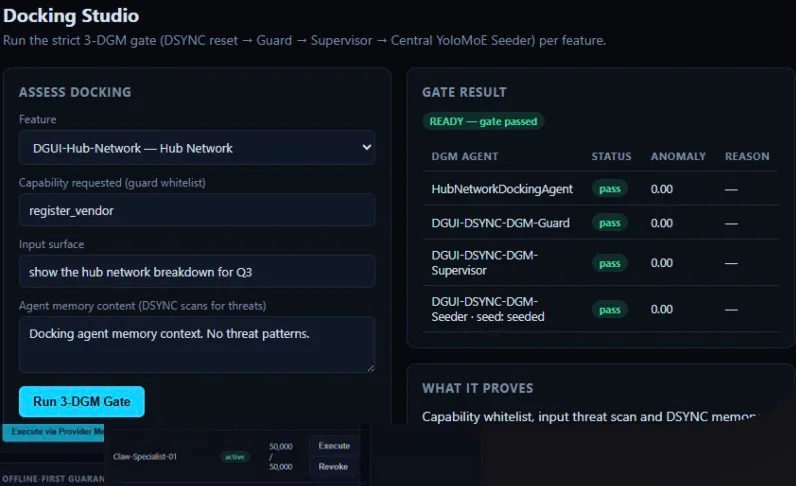
The Phase 3 Docking Station extends the concept further by providing charging, enterprise connectivity, work authentication, synchronization, maintenance, and local model updates.
The objective is not to eliminate cloud AI.
It is to ensure that AI capability does not have to exist exclusively in the cloud.
The AI Race Is Becoming a Systems Race
This is why I don’t believe the future AI race will be determined exclusively by whoever develops the smartest model.
Model intelligence will remain extremely important.
But the broader system may matter just as much.
I see the future competition as something closer to:
Model Intelligence
- ●
Agent Architecture
- ●
Compute
- ●
Electricity
- ●
Cooling
- ●
Hardware
- ●
Efficiency
- ●
Energy Recovery
- ●
Governance
- ●
Ownership
The winning architecture may therefore not be the one with the largest model alone.
It may be the architecture capable of transforming limited physical resources into the greatest amount of useful intelligence, while maintaining security, efficiency, resilience, governance, and control.
My Current Learning
For me, this changes how I think about AI development.
I don’t want DeckerGUI to exist simply as another interface sitting on top of an LLM.
I’m interested in the larger question:
What does an AI-native computing ecosystem look like when software, agents, hardware, energy, governance, and ownership are designed together?
That is why local AI matters to me.
That is why frontier models matter too.
That is why agent harnesses matter.
That is why hardware matters.
And eventually, that is why electricity and thermal management may matter almost as much as the models themselves.
Beyond AGI
And then we arrive at the part where things get considerably more speculative.
If we eventually move from increasingly capable AI toward stable AGI, the trajectory may not stop there.
My personal mental model is something like:
AGI → ASI → Quantum Foundation Era → UAI/QAI → ACI → AHI
Of course, the further we move along that chain, the more speculative the terminology and timeline become.
I don’t pretend to know exactly what those transitions will look like.
But I find the direction fascinating.
If AGI becomes capable of accelerating scientific discovery, engineering, automation, and infrastructure development, then ASI could potentially become less about simply being a “smarter chatbot” and more about becoming an engine for accelerating entire technological ecosystems.
From there, quantum computing and quantum-native AI could introduce another computational paradigm.
And beyond that?
Well…
Good luck, youngster. We probably won’t be alive. 😂
Which is exactly why I’m reserving my seat in advance.
DeLorean DMC-12.
Modified Flux Capacitor.
Mr. Fusion.
No questions asked.
The Infrastructure Era
Perhaps the most important lesson I am taking from all of this is simple:
Infrastructure is the future.
Models will evolve.
Products will evolve.
Frameworks will evolve.
Agent architectures will evolve.
But someone still has to build the infrastructure that allows all of those things to operate.
The more builders we can bring together inside a collective ecosystem, the more capable that ecosystem can become.
That is what I envision with KRACKED DEVS.
Not simply another community around a particular model.
Not simply another product ecosystem.
But an infrastructure-building collective.
A place where builders can contribute different pieces of the stack:
Models → Agents → Tools → Applications → Infrastructure → Hardware → Energy → Ecosystems
Because the real multiplier may not be one brilliant builder.
It may be many builders building interoperable systems together.
That is where I believe a community can become significantly greater than any individual model or product.
And perhaps that is ultimately the direction I want to see KRACKED DEVS grow toward:
From developers using infrastructure, into developers building infrastructure.
Final Thought
Perhaps the future isn’t simply about building a smarter AI.
Perhaps it is about building the infrastructure capable of sustaining, governing, owning, securing, and efficiently operating intelligence at scale.
And if future AI infrastructure can generate intelligence while simultaneously recovering useful thermal energy for the physical world, then we may eventually discover that the most valuable resource surrounding AI isn’t just compute.
It is energy that can be continuously transformed, reused, and converted into useful work.
That’s why I keep saying:
Thermal energy could become the “new currency.” 😂
Not literally money.
But potentially one of the most important forms of physical value in an AI-driven economy.
And that is where my current learning leads me.
Salute to the Builders
One last thing.
Infrastructure is the future.
The more builders we can bring together collectively within one ecosystem, the more we can become.
That is what I envision KRACKED DEVS becoming: an infrastructure-building collective capable of growing beyond any single model, product, or project.
Kudos to the ambassadors.
Kudos to everyone contributing.
Kudos to brother Dani.
And kudos to cfu, pali, matnep, mii, pazi, adam, and everyone else I have had the opportunity to know, whether before Day 1 or after.
Every builder contributes something.
Every connection adds another layer.
Every experiment teaches something.
Every project becomes another piece of the infrastructure.
Salute.
Yours Truly,
ctaxnagomi
Olympic Dancer
Comments 0
Sign in to comment.