Loading community...
OpenCode Free Tier Limit Fixes: Comprehensive Solutions for OpenCode Bug Free Tier and Free Usage Limit Reached Errors


OpenCode Free Tier Limit Fixes: Comprehensive Solutions for OpenCode Bug Free Tier and Free Usage Limit Reached Errors
Wan Mohd Azizi @ctaxnagomi
Applied Agentic AI Engineer | UAEL | CTECX | DeckerGUI Agentic Integration Hybrid Ecosystem | KD Ambassador Sarawak
October 29, 2026
Abstract
This paper addresses the pervasive OpenCode free tier limit issues encountered by developers using OpenCode's hosted free models such as Big Pickle and DeepSeek V4.1 Flash Free. Focusing on opencode free tier limit fixes and opencode bug free tier scenarios, we detail error messages, root causes including version incompatibilities in OpenCode v1 versus v2, IP-based abuse detection, and practical workarounds. A key possible factor identified is that the free-tier gateway employs SDK-gated proxy mechanisms that enforce IP restrictions rather than strict per-account quotas. Key strategies include updating to OpenCode v2, connecting external providers, and leveraging community resources for sustained agentic AI development with effective opencode free tier limit fixes.
Keywords: OpenCode free tier limit fixes, opencode bug free tier, free usage limit reached, OpenCode free models, OpenCode v2 update, Big Pickle free model, agentic AI coding tools, free usage exceeded OpenCode, SDK gated proxy IP restrictions
1. Problem Statement
OpenCode users, particularly those relying on free hosted models (Big Pickle, DeepSeek V4.1 Flash Free, and other Console/Zen free endpoints), experience sudden interruptions marked by free usage limit reached errors such as “Free usage limit reached,” “Free usage exceeded, subscribe to Go,” and “OpenCode’s free models aren’t available from your current network because we’ve detected abusive traffic from this IP address.” These blocks related to opencode bug free tier occur even on the first request of the day, with zero usage recorded in the Console, or with countdowns that reset without clearing the restriction. The problem is especially acute for users on OpenCode v1 (0.x / 1.x), shared networks, VPNs, or when the client is configured with certain permissions or plugins. The result is broken agentic coding workflows, loss of productivity, and forced migration to paid tiers or external providers. Identifying accurate root causes and reliable opencode free tier limit fixes is therefore critical for both individual developers and teams building on open agentic tooling.
A further complication is the opaque nature of the free-tier enforcement for opencode free tier limit fixes. OpenCode does not publish the exact allowance size or reset schedule. Community reports and GitHub issues (notably #59387 and related threads) indicate that many “free usage limit reached” cases are not pure per-account quota exhaustion. Instead, evidence points toward network-level and client-origin gating related to the opencode bug free tier. This paper isolates these factors and proposes practical solutions.
2. Introduction to OpenCode Free Tier Limit Issues
OpenCode, an open-source coding agent supporting terminal, desktop, and IDE environments, provides free models via its hosted gateway (previously Zen, now Console in v2 documentation). These include models such as Big Pickle free model and DeepSeek V4.1 Flash Free. However, users frequently encounter free usage limit reached or 'Free usage exceeded' errors, which halt coding sessions. This phenomenon, often termed the opencode bug free tier, stems from server-side allowances, version mismatches, and network detection mechanisms. Effective opencode free tier limit fixes are essential for developers relying on free tiers for agentic AI coding tools, particularly in educational and prototyping contexts.
As of October 26, 2026, OpenCode maintainers identified that the majority of free-tier problems and opencode bug free tier issues originate from OpenCode v1 (versions 0.x and 1.x), which no longer fully supports free models. Updating to OpenCode v2 update (e.g., 2.1.4) resolves the issue for many users seeking opencode free tier limit fixes. The built-in updater in v1 desktop applications keeps users on 1.x, necessitating a manual download from opencode.ai/v2/docs. This paper provides a comprehensive guide to opencode free tier limit fixes, drawing from official documentation, GitHub issues such as #59387, and community reports.
3. Comparison of OpenCode V1 versus OpenCode V2
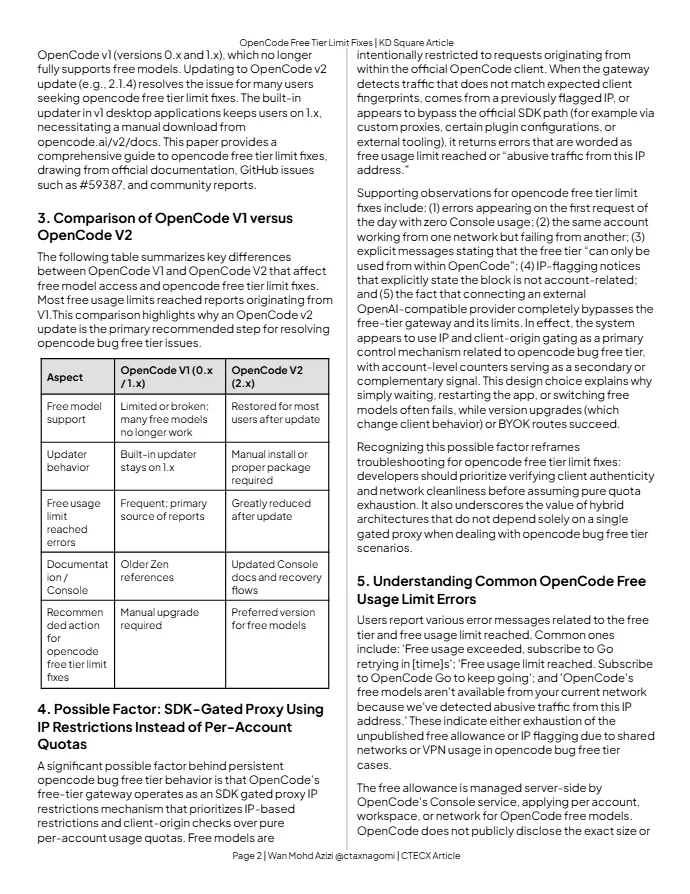
The following table summarizes key differences between OpenCode V1 and OpenCode V2 that affect free model access and opencode free tier limit fixes. Most free usage limits reached reports originating from V1.This comparison highlights why an OpenCode v2 update is the primary recommended step for resolving opencode bug free tier issues.
| Aspect | OpenCode V1 (0.x / 1.x) | OpenCode V2 (2.x) |
|---|---|---|
| Free model support | Limited or broken; many free models no longer work | Restored for most users after update |
| Updater behavior | Built-in updater stays on 1.x | Manual install or proper package required |
| Free usage limit reached errors | Frequent; primary source of reports | Greatly reduced after update |
| Documentation / Console | Older Zen references | Updated Console docs and recovery flows |
| Recommended action for opencode free tier limit fixes | Manual upgrade required | Preferred version for free models |
4. Possible Factor: SDK-Gated Proxy Using IP Restrictions Instead of Per-Account Quotas
A significant possible factor behind persistent opencode bug free tier behavior is that OpenCode’s free-tier gateway operates as an SDK gated proxy IP restrictions mechanism that prioritizes IP-based restrictions and client-origin checks over pure per-account usage quotas. Free models are intentionally restricted to requests originating from within the official OpenCode client. When the gateway detects traffic that does not match expected client fingerprints, comes from a previously flagged IP, or appears to bypass the official SDK path (for example via custom proxies, certain plugin configurations, or external tooling), it returns errors that are worded as free usage limit reached or “abusive traffic from this IP address.”
Supporting observations for opencode free tier limit fixes include: (1) errors appearing on the first request of the day with zero Console usage; (2) the same account working from one network but failing from another; (3) explicit messages stating that the free tier “can only be used from within OpenCode”; (4) IP-flagging notices that explicitly state the block is not account-related; and (5) the fact that connecting an external OpenAI-compatible provider completely bypasses the free-tier gateway and its limits. In effect, the system appears to use IP and client-origin gating as a primary control mechanism related to opencode bug free tier, with account-level counters serving as a secondary or complementary signal. This design choice explains why simply waiting, restarting the app, or switching free models often fails, while version upgrades (which change client behavior) or BYOK routes succeed.
Recognizing this possible factor reframes troubleshooting for opencode free tier limit fixes: developers should prioritize verifying client authenticity and network cleanliness before assuming pure quota exhaustion. It also underscores the value of hybrid architectures that do not depend solely on a single gated proxy when dealing with opencode bug free tier scenarios.
5. Understanding Common OpenCode Free Usage Limit Errors
Users report various error messages related to the free tier and free usage limit reached. Common ones include: 'Free usage exceeded, subscribe to Go retrying in [time]s'; 'Free usage limit reached. Subscribe to OpenCode Go to keep going'; and 'OpenCode's free models aren't available from your current network because we've detected abusive traffic from this IP address.' These indicate either exhaustion of the unpublished free allowance or IP flagging due to shared networks or VPN usage in opencode bug free tier cases.
The free allowance is managed server-side by OpenCode's Console service, applying per account, workspace, or network for OpenCode free models. OpenCode does not publicly disclose the exact size or reset schedule of this limit. In some cases, free usage exceeded OpenCode errors appearing on the first request of the day with zero usage shown in the Console, suggesting potential bugs in limit tracking, particularly in older versions. Another error, 'OpenCode's free tier can only be used from within OpenCode,' occurs when requests originate outside the official client or due to configuration issues like denied shell permissions or incorrect provider settings pointing to the free endpoint, requiring targeted opencode free tier limit fixes.
6. Primary OpenCode Free Tier Limit Fixes: Updating to Version 2
The most effective opencode free tier limit fix for many is upgrading from OpenCode v1 to OpenCode v2 update. To check your version, run opencode --version in the terminal or check Settings → About in the desktop app. For v1 users: download the v2 desktop app from opencode.ai/v2/docs, or on macOS use brew install --cask opencode-desktop. For terminal installations, use curl -fsSL https://opencode.ai/v2/install | bash on macOS/Linux, or npm install -g @opencode/cli. Uninstall prior v1 packages first if installed via package managers. Maintainers confirm that this update resolves free model access and opencode bug free tier issues for numerous reports pinned under GitHub issue #59387.
If already on the latest v2 and still facing free usage limit reached limits, options include waiting for the reset (check OpenCode Console), contacting support at help@anoma.ly, or subscribing to OpenCode Go. For Go subscribers still seeing free limits, run /connect, select OpenCode Go, provide the API key, and select Go models (opencode-go/...) instead of free ones (opencode/...-free) as part of opencode free tier limit fixes.
7. Additional Workarounds and Solutions for Opencode Bug Free Tier and IP-Gated Restrictions
Beyond version updates, several strategies address opencode bug free tier problems and the possible SDK gated proxy IP restrictions factor. Connecting your own provider via OpenAI-compatible APIs bypasses OpenCode's free tier entirely, as requests do not route through the free gateway. Tools like TeamoRouter or other aggregators facilitate this. Local models via Ollama or LM Studio provide unlimited offline usage, ideal for privacy-sensitive or high-volume agentic AI coding tools.
For IP-related blocks specifically related to free usage limit reached: turn off VPNs, proxies, and any intermediate gateways; test from a different network or mobile hotspot; and email help@anoma.ly requesting IP review if the block persists on a clean connection. Configuration checks using opencode debug config and opencode auth list can resolve 'free tier only within OpenCode' errors by fixing permission denials (especially shell/bash), removing leftover plugins, and ensuring no provider entry points at the free zen endpoint. Setting OPENCODE_DISABLE_FREE_MODELS=1 hides free models when preferred. These opencode free tier limit fixes ensure continuity in coding agent workflows even when the free-tier proxy applies IP-centric gating.
Additional practical steps for opencode free tier limit fixes include: verifying that the request path remains inside the official OpenCode process (avoid external HTTP clients hitting free endpoints), clearing cached credentials and re-authenticating, and monitoring the Console for any reset timestamp that does appear. When the IP-restriction factor is dominant in opencode bug free tier cases, the most reliable long-term solutions remain BYOK to an external provider or migration to a local model stack.
8. Implications for Agentic AI Development and Community Resources
Reliable access to free tiers is critical for scaling agentic AI coding tools, especially in regions building local infrastructure. Issues with OpenCode free models and free usage limit reached errors highlight the need for robust hybrid ecosystems that support multi-provider orchestration, edge computing, and decision-gated compliance layers. Developers facing these limits and seeking opencode free tier limit fixes can benefit from communities focused on practical agentic implementations.
9. Conclusion
In summary, opencode free tier limit fixes primarily involve upgrading to OpenCode v2 update, managing provider connections, cleaning network paths, and addressing the possible factor of SDK gated proxy IP restrictions rather than pure per-account quotas. By following the steps outlined (version verification, manual v2 installation, support engagement, BYOK strategies, and network hygiene) developers can maintain productivity when encountering free usage limit reached or opencode bug free tier issues. As agentic AI tools evolve, community-driven solutions like those from DeckerGUI and KrackedDevs provide complementary infrastructure for sustainable development. Future work should monitor OpenCode updates for improved free tier transparency and clearer separation between account quotas and IP-origin gating.
KrackedDevs are expanding to Borneo! Join us! Join the KrackedDevs Community here! Follow: @krackeddevs at Threads | Instagram | X.Twitter | Official website | Discord. www.krackeddevs.com. Want to learn? Online @ RakyatDigital. Offline in-person @AIBuilderAcademy. We are currently building Agentic Infrastructure for Industries: DeckerGUI (DeckerGUI.my). Features include Agentic AI, Edge-Computing, Edge-AI, Multi-Node Orchestration, Decision Gated layer Compliances, DGM | DLLIM | HUB .NET | PERSONA | MARKET | AFM, and AI Infrastructure for Enterprise and Individual on your hand.
Glossary
OpenCode free tier limit fixes - Practical steps and configuration changes that restore access to OpenCode’s free models after encountering usage or network blocks.
Opencode bug free tier - Community term describing unexpected free-tier restrictions, including first-request blocks, non-clearing countdowns, and version-related failures.
Free usage limit reached - The primary error message displayed when OpenCode’s free-tier gateway refuses a request due to allowance, IP, or client-origin checks.
SDK gated proxy IP restrictions - Possible enforcement mechanism in which free-model requests are validated by client origin and source IP rather than (or in addition to) pure per-account quotas.
OpenCode v2 update - Migration from OpenCode 0.x/1.x to version 2.x, which restores free-model support for many users.
Big Pickle free model - One of the temporary free models offered through OpenCode’s hosted Console/Zen gateway.
BYOK (Bring Your Own Key) - Connecting an external OpenAI-compatible provider so that requests bypass OpenCode’s free-tier gateway entirely.
Agentic AI coding tools - Software systems that use large language models to autonomously or semi-autonomously perform software engineering tasks inside environments such as OpenCode.
References
[1] TeamoRouter. OpenCode 'Free Usage Limit Reached': What It Means and How to Keep Coding. https://teamorouter.com/blogs/opencode-free-usage-limit. Accessed October 29, 2026.
[2] OpenCode GitHub Issue #59387: Free-tier problems (main pinned issue). https://github.com/anomalyco/opencode/issues/59387. Accessed October 2026.
[3] OpenCode GitHub Issues #58781, #58941, #58205, #58284, #58814, #59140, #56324, #56916, #57074, #50627. https://github.com/anomalyco/opencode. Accessed October 2026.
[4] OpenCode V2 Documentation and Install Guide. https://opencode.ai/v2/docs. Accessed October 2026.
[5] OpenCode Console Models Documentation. https://opencode.ai/v2/docs/console/models. Accessed October 2026.
[6] OpenCode Changelog and Release Notes related to free-limit recovery (v2.1.2 and later). https://opencode.ai. Accessed October 2026.
[7] Community reports on free usage exceeded and IP flagging. Various GitHub issues and forums, October 19-26, 2026.
This article is prepared in dual-column format for academic and SEO/AEO/GEO dissemination, emphasizing practical opencode free tier limit fixes and the possible factor of SDK-gated IP restrictions.
Prefer Reading Image-based ?
Comments 0
Sign in to comment.