Loading community...
DREAM RSI X ToT (Ready for your agents to be generatively progressive in learning)

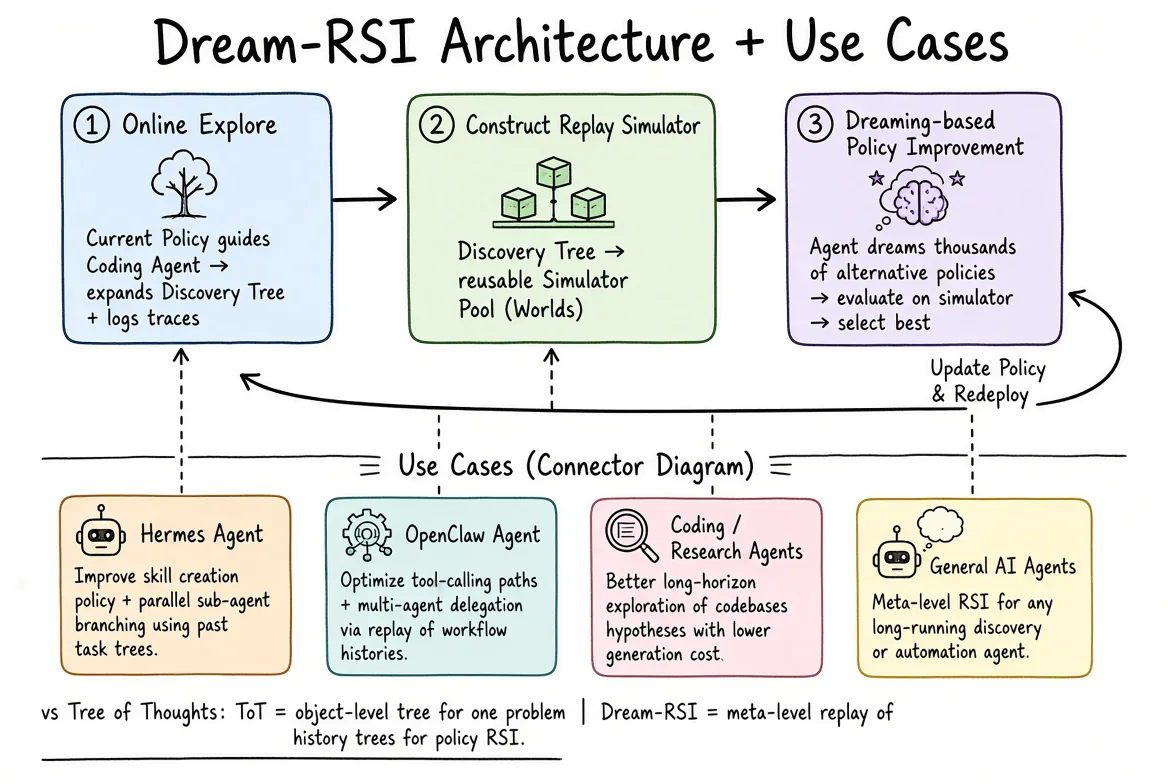 Dream-RSI vs Tree of Thoughts (ToT)
Tree of Thoughts (ToT)
• Object-level reasoning technique.
• LLM explore multiple intermediate “thoughts” dalam tree structure untuk solve satu problem.
• Ada deliberate BFS/DFS, evaluation, pruning, backtracking.
• Focus: better reasoning path for current task.
• Static per query — no memory of past trees, no policy improvement across tasks.
Dream-RSI
• Meta-level exploration framework.
• Treat whole discovery history (past trees of attempts + outcomes) as replay simulator.
• Agent “dream” (off-policy) test ribuan alternative exploration policies tanpa real cost.
• Improved policy redeploy online → recursive self-improvement loop.
• Focus: improve how the agent explores across many tasks over time.
So What does it do if apply to current Hermes/Openclaw/AI Agents setup?
• Hermes → best fit sebab dia already ada learning loop + skill creation. Dream-RSI upgrade meta-exploration layer dia.
• OpenClaw → bagus untuk optimize tool/skill usage & multi-agent routing, especially sebab dia heavy on real actions (expensive kalau salah).
• Lain-lain → mana-mana agent yang buat long search / trial-and-error, Dream-RSI boleh buat dia improve cara dia explore tanpa perlu retrain model besar.
Use-case Dream-RSI dekat Hermes Agent, OpenClaw Agent & AI agent lain (Bahasa pasar style)
Dream-RSI punya idea main: buat history exploration jadi replay simulator (boleh “dream” test ribuan strategy tanpa spend real compute). Ni boleh apply terus ke agent yang long-running & self-improving macam Hermes & OpenClaw.
1. Hermes Agent (Nous Research)
Hermes memang self-improving — dia create skill sendiri, ada persistent memory, parallel sub-agent, learning loop.
Use-case Dream-RSI:
• Optimize skill creation & exploration policy
Sekarang Hermes explore task → create skill. Dengan Dream-RSI, dia boleh “dream” atas history of past tasks (tree of attempts + outcomes) untuk improve cara dia decide “bila nak create skill baru vs refine skill lama”, “berapa deep nak explore satu direction”, “bila nak spawn parallel sub-agent”.
Result: skill yang lebih useful, less wasted runs, faster improve over time.
• Better parallel exploration
Hermes boleh spawn multiple sub-agents. Dream-RSI boleh refine policy: mana branch yang worth deepen, mana yang stop early, how to batch parallel work — semua based on past discovery trees, without rerun expensive tasks.
• Long-horizon personal agent
Kalau Hermes run daily automation / research / coding for you, Dream-RSI boleh buat dia self-improve exploration strategy across weeks/months, so dia jadi smarter allocate compute.
2. OpenClaw Agent
OpenClaw more gateway + skills + multi-channel (WhatsApp, Telegram, Discord, etc.), persistent, tool-heavy, boleh run 24/7.
Use-case Dream-RSI:
• Optimize tool-calling & skill exploration
OpenClaw ada skills system (SKILL.md). Dream-RSI boleh treat past tool-use histories as replay simulator. Agent “dream” different order of tool calls, different skill combinations, when to stop/retry — tanpa real API call or browser action.
Result: less wasted tool calls, faster task completion, better success rate on complex multi-step workflows.
• Multi-agent / delegation strategy
OpenClaw support multiple agents / routing. Dream-RSI boleh improve policy: “bila nak delegate ke specialist agent”, “how to parallelize subtasks”, “when to consolidate results” — based on past successful/failed workflow trees.
• 24/7 automation efficiency
Karena dia long-running, Dream-RSI boleh continuously refine exploration policy offline (semasa low load), then redeploy improved policy for next live tasks. Save cost (API tokens + compute).
Dream-RSI ni framework yang buat AI agent boleh recursively self-improve strategy exploration dia (bukan just solution yang dia jumpa).
Masalah Utama
Long-horizon discovery (algorithm design, math optimization, GPU kernel, etc.) kena buat ribuan trial-and-error. Fixed exploration policy buat waste compute. Kalau nak optimize exploration policy online, mahal gila sebab feedback delayed dan kena full rollout yang expensive.
Idea Utama
Treat past discovery history sebagai replay simulator (“world”).
Lepas agent explore dan record tree of attempts + outcomes, dia boleh “dream” — test ribuan alternative exploration policy dengan cepat secara off-policy, just replay different path dalam tree yang already recorded. No need new expensive agent call or evaluation. Best improved policy then redeploy online, generate new history, expand simulator pool. Jadi close the RSI loop kat meta-exploration level.
Cara Dia Kerja (3 stages)
1. Online Explore — Current policy guide coding agent expand discovery tree.
2. Construct Replay Simulator — Convert tree tu jadi reusable simulator.
3. Dreaming-based Policy Improvement — Generate & evaluate many candidate policies dalam simulator → pilih yang best → redeploy.
Only exploration policy code yang change; underlying coding agent & evaluator stay fixed.
Results
Test kat algorithm engineering (Lasso path), math optimization (sum-difference, autocorrelation, circle packing), dan GPU kernel engineering (KernelBench):
• Solution quality competitive or better.
• Often cost jauh lebih rendah: up to 162× fewer agent calls vs SimpleTES, 1.7–2.4× fewer generations vs fixed-exploration baseline, or higher performance under same budget.
Bottom line: By convert exploration history jadi cheap “dream” simulator, Dream-RSI allow agent efficiently improve cara dia explore, and close practical recursive self-improvement loop.
Comments 0
Sign in to comment.