Loading community...
DGUI HyperMem MCP: Hybrid Memory for Autonomous Agents - Why You Need It and Real-World Use Cases

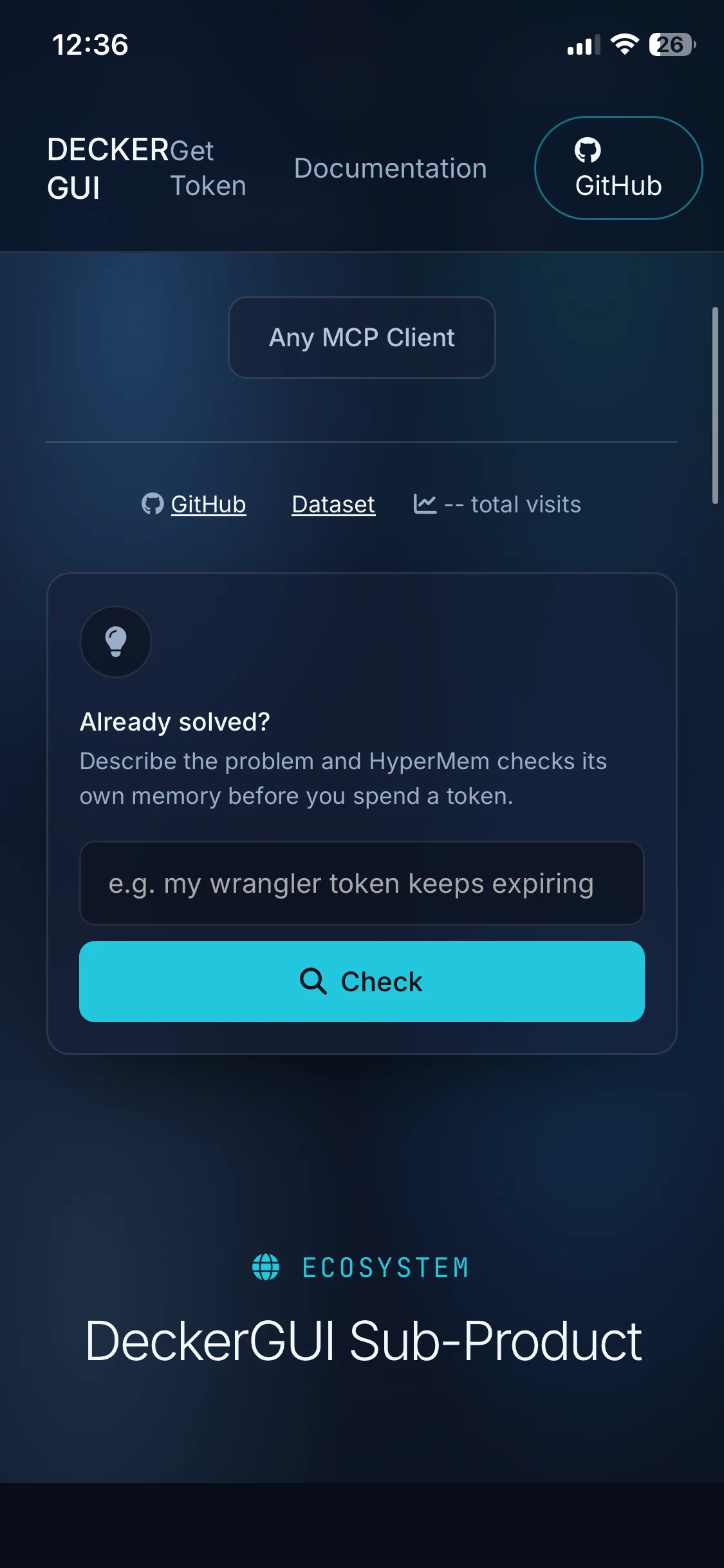
DGUI HyperMem MCP: Hybrid Memory for Autonomous Agents - Why You Need It and Real-World Use Cases
Wan Mohd Azizi @ctaxnagomi
Applied Agentic AI Engineer | UAEL | CTECX | DeckerGUI Agentic Integration Hybrid Ecosystem | KD Ambassador Sarawak
November 11, 2026
Abstract
This paper introduces DGUI HyperMem, a self-hosted hybrid long-term memory MCP server for AI agents running on Cloudflare Workers. It fuses vector search, full-text search, and a JEV reasoning layer that curates every memory with type, salience, and durability scores. Focusing on DGUI HyperMem MCP usage, we explain how to connect and use the tools, why persistent memory is essential for autonomous architecture, and real-world use cases in agentic systems, edge computing, and free automation. Proper use of DGUI HyperMem eliminates the need for paid memory platforms by giving agents durable recall without training or complex setup.
Keywords: DGUI HyperMem MCP, hybrid memory MCP server, JEV reasoning layer, autonomous agents memory, free agent memory, DeckerGUI HyperMemory, MCP tools add search list, real world MCP use cases, Cloudflare Workers memory
1. Problem Statement
Autonomous agents and agentic systems fail when they cannot remember context across sessions. Most developers either rebuild memory from scratch for every interaction or pay for commercial memory platforms that lock data behind subscriptions. DGUI HyperMem MCP solves this by providing a free or low-cost hybrid memory layer that any MCP-compatible client can use. Without durable memory, agents cannot maintain project state, user preferences, or learned solutions, forcing repeated explanations and higher token costs. The problem is not the lack of AI models; it is the absence of a curated, hybrid memory system that agents can trust.
DGUI HyperMem addresses this gap as a DeckerGUI sub-product. It stores only durable memories after a JEV reasoning layer evaluates type, salience, and durability. Near-duplicates and contradictions are superseded automatically. This creates reliable free agent memory that scales from individual hobbyists to enterprise multi-node orchestration without vendor lock-in.
2. What Is DGUI HyperMem MCP
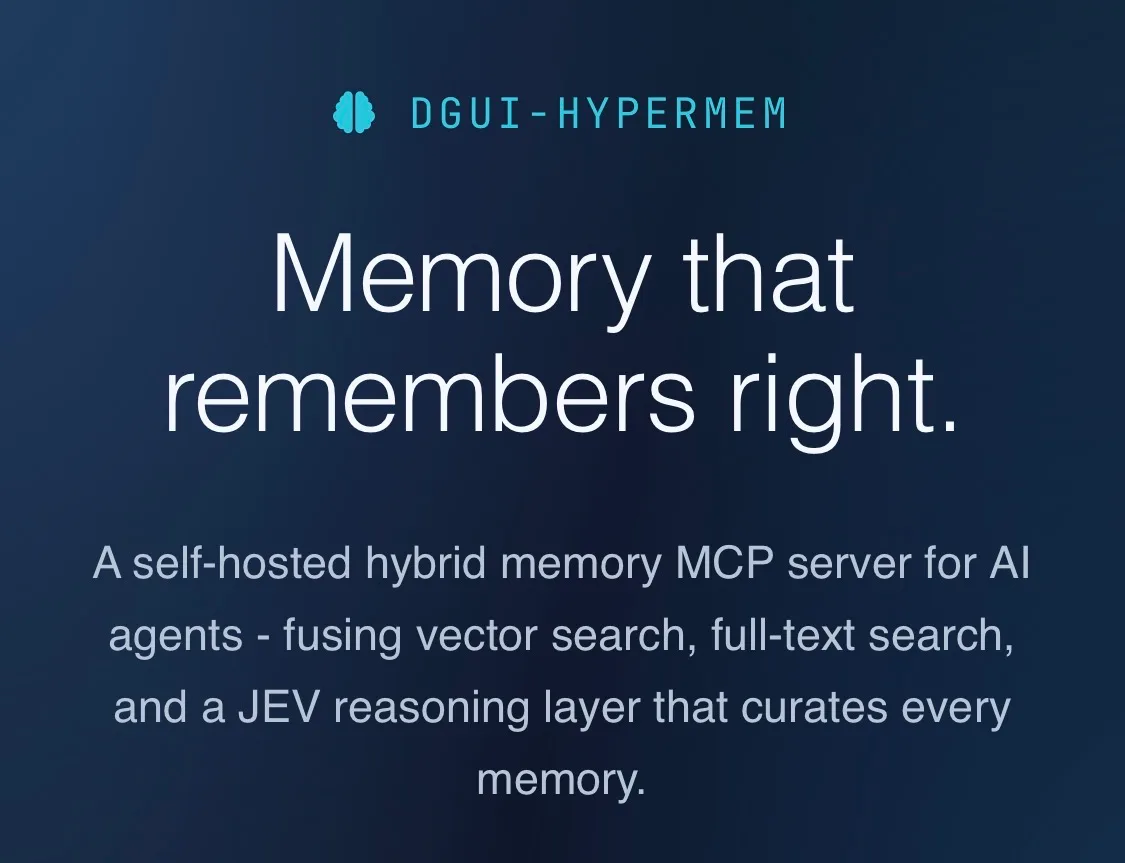
DGUI HyperMem is a self-hosted hybrid long-term memory MCP server running on Cloudflare Workers. Retrieval fuses Cloudflare Vectorize approximate nearest neighbor search with D1 full-text search (FTS5 BM25), then a JEV reasoning layer (Choice, Noul, Score from TypeSafe AI) re-ranks candidates so the most relevant memory wins even when wording differs. It supports scopes for different users or projects and corpus types including universal, session, and gen_idle. Compatible with any MCP client such as Claude Desktop, Cursor, OpenCode, Hermes, or custom agents.
The stack uses Cloudflare Workers (ES modules), MCP Streamable HTTP via the official SDK, D1 database, Vectorize with bge-base-en-v1.5 embeddings, and JEV for curation. Authentication accepts Bearer token, x-api-key, or query parameter. Free tier offers 32,000 requests per month; pay-as-you-go is approximately $0.002 per request. Enterprise options provide dedicated infrastructure and higher quotas. This design makes DGUI HyperMem MCP practical for real-world autonomous architecture without expensive cloud memory services.
3. How to Use the MCP
Connect any MCP client to the endpoint (typically dgui-hmem.deckergui.my or your self-hosted Worker) using the MCP token. Core tools are add, search, list, profile, forget, and help. To store a memory, call add with content, optional tags, scope, source, and corpus_type. JEV automatically classifies it. To recall, call search with a natural language query; the hybrid engine returns re-ranked results. List and profile help browse or summarise a scope. Forget removes unwanted memories by id or query. Additional tools support dataset sync for the HuggingFace training flywheel.
Example flow for free automation: an agent calls add after completing a task to store the solution, then later calls search when a similar problem appears. Because memories carry salience and durability, low-value chatter is dropped while high-value project decisions persist. This pattern works across sessions and devices without paid platforms. The table below summarises the main tools.
| MCP Tool | Purpose in Autonomous Architecture |
|---|---|
| add | Store durable memory; JEV assigns type, salience, durability and can supersede contradictions |
| search | Hybrid recall: vector + keyword candidates, fused, then JEV re-ranked for best match |
| list / profile | Browse recent memories or summarise a scope by type and tags |
| forget | Delete by id, query, or entire scope for controlled memory hygiene |
These MCP tools form the foundation of durable memory for autonomous agents. Proper use of DGUI HyperMem MCP keeps token costs low and context accurate.
4. Why You Need DGUI HyperMem
Agents without memory repeat work, lose user preferences, and cannot accumulate solutions over time. Commercial memory services add cost and data residency concerns. DGUI HyperMem MCP provides hybrid recall that works even when the query wording differs from the stored memory, thanks to vector search plus JEV re-ranking. Self-maintenance via supersede prevents contradictory memories from accumulating. The result is free or low-cost agent memory that supports multi-node orchestration, edge devices, and long-running autonomous workflows.
In the DeckerGUI ecosystem, HyperMem supplies the memory layer for personas, AFM jobs, and decision-gated compliance. Developers who master the MCP tools avoid rebuilding context in every prompt and reduce reliance on expensive context windows or paid agent platforms. Real-world autonomous architecture becomes practical when memory is durable, curated, and accessible via standard MCP.
5. Real-World Use Cases
Educational agent: a study buddy stores solved problems and explanations via add. Later search retrieves the exact solution even if the student rephrases the question. No paid tutoring platform is required.
Project continuity: a coding agent stores architecture decisions and API patterns in a project scope. Across days or machines, search restores the relevant decisions, enabling free multi-session development without external knowledge bases.
Edge and multi-node: edge devices store local session memories while a central HyperMem holds universal knowledge. Agents query both, supporting offline-first autonomous systems. Industry use cases include compliance-gated workflows where decision records must persist and be auditable.
Personal knowledge: researchers store paper notes and findings. Hybrid search surfaces related work even when terminology differs. Combined with DeckerGUI personas, this creates a free personal research assistant that improves over time.
works on Grok Mobile
6. Conclusion
DGUI HyperMem MCP supplies the missing durable memory layer for autonomous agents. By combining hybrid retrieval with JEV curation, it enables free or low-cost agent memory that commercial platforms charge for. Connecting any MCP client, using the add and search tools, and organising memories into scopes unlocks real-world use cases from education to multi-node orchestration. Teams that adopt DGUI HyperMem reduce token waste, preserve project knowledge, and build reliable agentic systems without vendor lock-in.
KrackedDevs are expanding to Borneo! Join us! Join KrackedDevs Community here! Follow: @krackeddevs at Threads | Instagram | X.Twitter | Official website | Discord. www.krackeddevs.com. Want to learn? Online @ RakyatDigital. Offline in-person @AIBuilderAcademy. We are currently building Agentic Infrastructure for Industries: DeckerGUI (DeckerGUI.my). Features include Agentic AI, Edge-Computing, Edge-AI, Multi-Node Orchestration, Decision Gated layer Compliances, DGM | DLLIM | HUB .NET | PERSONA | MARKET | AFM, and AI Infrastructure for Enterprise and Individual on your hand.
Glossary
DGUI HyperMem MCP - Self-hosted hybrid memory server implementing the Model Context Protocol for AI agents.
JEV reasoning layer - TypeSafe AI Choice / Noul / Score system that assigns type, salience, and durability to memories and re-ranks search results.
Hybrid recall - Fusion of vector similarity search and full-text keyword search, followed by JEV re-ranking.
MCP - Model Context Protocol; standard interface that lets AI clients call tools such as add and search.
Scope - Independent memory space for a user, project, or agent.
Supersede - Automatic replacement of near-duplicate or contradicting memories by JEV.
References
[1] DGUI-HyperMem official site. https://dgui-hmem.deckergui.my/. Accessed November 2026.
[2] GitHub repository ctaxnagomi/dgui-hypermem. https://github.com/ctaxnagomi/dgui-hypermem. Accessed November 2026.
[3] DeckerGUI ecosystem. https://deckergui.my/. Accessed November 2026.
[4] TypeSafe AI JEV documentation. https://docs.typesafe.ai. Accessed November 2026.
in BAHASA MALAYSIA
DGUI HyperMem MCP Guide | KD Square Article
DGUI HyperMem MCP: Introductory Guide, Unified Corpus Memory, Contributor-Based Fetching, and Real-World Use Cases
Wan Mohd Azizi @ctaxnagomi
Applied Agentic AI Engineer | UAEL | CTECX | DeckerGUI Agentic Integration Hybrid Ecosystem | KD Ambassador Sarawak
November 12, 2026
Abstract
This article introduces DGUI HyperMem, a self-hosted hybrid memory MCP server for AI agents. It covers the MCP interface, how to connect and use the tools, what users can expect, the unified corpus memory system, and the latest contributor-based memory fetching capability. Sample use cases demonstrate practical application on mobile and desktop clients including ChatGPT, Grok, and Claude via connector features. Accurate details are drawn from the official documentation at dgui-hmem.deckergui.my and the GitHub repository.
Keywords: DGUI HyperMem MCP, unified corpus memory, contributor based memory fetch, MCP connector ChatGPT Grok Claude, hybrid memory agent, JEV reasoning layer, free agent memory, DeckerGUI HyperMemory
1. Introduction to DGUI HyperMem MCP
DGUI HyperMem is a self-hosted hybrid long-term memory MCP server for AI agents, running on Cloudflare Workers as a DeckerGUI sub-product. Available at https://dgui-hmem.deckergui.my, it fuses vector search (Cloudflare Vectorize) with full-text search (D1 FTS5) and applies a JEV reasoning layer (Choice / Noul / Score from TypeSafe AI) to curate every memory. It assigns type, salience, and durability, drops non-durable chatter, and automatically supersedes near-duplicates or contradictions. Compatible with any MCP client including Claude Desktop, Cursor, OpenCode, Hermes, and mobile apps that support remote MCP connectors such as ChatGPT, Grok, and Claude.
What to expect: instant recall without training or complex setup, free tier of 32,000 requests per month (one token per email), and pay-as-you-go at approximately $0.002 per request. Enterprise plans offer dedicated infrastructure. Authentication uses a bearer token obtained after agreeing to Terms and Privacy Policy.
2. How to Use the MCP and What to Expect
Obtain a bearer token from the site by entering your email and passkey after reviewing the Terms and Privacy Policy. In your MCP client, add a remote server with URL https://dgui-hmem.deckergui.my/mcp and Authorization: Bearer YOUR_TOKEN. On mobile ChatGPT, Grok, or Claude, use the built-in connector or custom MCP feature to point to the same endpoint. Core tools include add (store memory with optional tags, scope, client_id, user_id), search (hybrid recall), list, profile, forget, and help. Expect JEV to classify memories automatically and return re-ranked results even when query wording differs from the stored text.
| MCP Tool | What to Expect |
|---|---|
| add | Stores memory; JEV assigns type, salience, durability; supports client_id/user_id for contributor attribution |
| search | Hybrid vector + FTS recall, JEV re-ranked; can filter by contributor metadata |
| list / profile | Browse or summarise memories in a scope, including contributor-tagged entries |
Sample connection for OpenCode or similar clients uses a JSON config with type remote and the bearer header. Mobile clients that support MCP connectors follow the same URL and auth pattern.
3. Unified Corpus Memory
DGUI HyperMem supports multiple corpus types. The universal corpus is shared and benefits all users (coding skills, design knowledge, document skills). Session corpus is local to a user or device and not included in the public HuggingFace dataset. Gen_idle memories are auto-generated and can be enriched back into the universal corpus. Every JEV decision is logged and periodically flushed to the HuggingFace dataset ctaxnagomi/DGUI_HYPERMEM-JEV, creating a training brain that improves the reasoning layer over time. This unified approach allows knowledge to accumulate while keeping private session data separate.
4. Latest Addition: Fetching Memory Based on Contributors
The latest contributor identity system requires every memory and contribution to carry the contributor's name and uid (for example ctaxnagomi). When calling add, pass client_id or user_id. The corpus can then attribute work correctly. Search and list operations can surface memories associated with specific contributors, enabling teams to retrieve knowledge created by particular people or agents. This is documented in the repository under Contributing through an MCP agent and Contributor identity sections. It supports collaborative free automation where credit and provenance matter.
5. Sample Use Cases
Mobile research assistant: On the ChatGPT or Grok mobile app, connect via MCP connector. Ask the agent to search HyperMem for notes previously added about a topic. The hybrid recall returns relevant memories even if phrased differently. Contributor filtering lets you retrieve only notes you or a specific teammate stored.
Coding agent continuity: In Claude Desktop or Cursor, store architecture decisions with user_id set to your uid. Later sessions call search to restore context without repeating prompts. Universal corpus memories from other contributors can be included when useful for shared skills.
Team knowledge base: Multiple agents add memories tagged with their contributor uids. A project lead searches with contributor filters to review contributions. This works on mobile or desktop MCP clients and supports free multi-node agentic workflows in the DeckerGUI ecosystem.
6. Versi Bahasa Malaysia (Ringkasan)
DGUI HyperMem ialah pelayan MCP memori hibrid jangka panjang yang dihos sendiri untuk ejen AI. Ia menggabungkan carian vektor, carian teks penuh, dan lapisan penaakulan JEV untuk mengurus setiap memori. Tersedia di https://dgui-hmem.deckergui.my. Pengguna boleh mengharapkan recall segera tanpa latihan, tier percuma 32,000 permintaan sebulan, dan sokongan untuk sebarang klien MCP termasuk aplikasi mudah alih ChatGPT, Grok, dan Claude melalui ciri connector.
Cara guna: Dapatkan token bearer dari laman web selepas bersetuju dengan Terma dan Polisi Privasi. Tambah pelayan jauh dengan URL https://dgui-hmem.deckergui.my/mcp dan header Authorization Bearer. Alat utama: add (simpan memori dengan client_id/user_id untuk atribusi penyumbang), search (recall hibrid), list, profile, forget. Korpus bersatu (universal) berkongsi pengetahuan; korpus sesi kekal peribadi. Penambahan terkini membolehkan pengambilan memori berdasarkan penyumbang menggunakan uid seperti ctaxnagomi. Kes penggunaan termasuk pembantu penyelidikan mudah alih dan kesinambungan projek kod tanpa platform berbayar.
7. Conclusion / Kesimpulan
DGUI HyperMem MCP provides durable, curated memory for autonomous agents through a simple connector interface. Unified corpus memory combined with contributor-based fetching enables collaborative knowledge that improves over time while preserving attribution. Users on mobile ChatGPT, Grok, Claude, or desktop clients can expect reliable hybrid recall and free-tier access after obtaining a token. This supports real-world free automation in education, coding, and multi-agent systems.
Kesimpulan: DGUI HyperMem MCP memberi memori tahan lama yang dikurasi untuk ejen autonomi melalui antaramuka connector yang mudah. Korpus bersatu dan pengambilan berdasarkan penyumbang membolehkan pengetahuan kolaboratif dengan atribusi yang jelas. Pengguna pada aplikasi mudah alih atau desktop boleh mengharapkan recall hibrid yang boleh dipercayai selepas mendapatkan token.
KrackedDevs are expanding to Borneo! Join us! Join KrackedDevs Community here! Follow: @krackeddevs at Threads | Instagram | X.Twitter | Official website | Discord. www.krackeddevs.com. Want to learn? Online @ RakyatDigital. Offline in-person @AIBuilderAcademy. We are currently building Agentic Infrastructure for Industries: DeckerGUI (DeckerGUI.my). Features include Agentic AI, Edge-Computing, Edge-AI, Multi-Node Orchestration, Decision Gated layer Compliances, DGM | DLLIM | HUB .NET | PERSONA | MARKET | AFM, and AI Infrastructure for Enterprise and Individual on your hand.
Glossary / Glosari
DGUI HyperMem MCP - Pelayan memori hibrid yang melaksanakan Model Context Protocol untuk ejen AI. / Hybrid memory server implementing MCP.
Unified corpus - Korpus universal yang dikongsi merentas pengguna, termasuk dataset latihan HuggingFace. / Shared universal corpus with training flywheel.
Contributor-based fetching - Pengambilan memori menggunakan client_id atau user_id (uid) untuk atribusi. / Retrieval filtered or attributed by contributor uid.
JEV - Lapisan penaakulan Choice / Noul / Score yang mengklasifikasi dan menyusun semula memori. / Reasoning layer for classification and re-ranking.
References
[1] Official DGUI-HyperMem site. https://dgui-hmem.deckergui.my/. Accessed November 2026.
[2] GitHub repository ctaxnagomi/dgui-hypermem README. https://github.com/ctaxnagomi/dgui-hypermem. Accessed November 2026.
[3] DeckerGUI ecosystem. https://deckergui.my/. Accessed November 2026.
Comments 0
Sign in to comment.