How might we use AI and 5G to generate actionable insights from visitor movement and activity patterns, improving customer flow, space utilisation and operational response?
Understanding how visitors move, queue and use spaces can help businesses and service teams improve customer experiences and respond to changing demand. However, information about these patterns is often fragmented or difficult to interpret, limiting its value for operational decisions.
The challenge is to translate movement and activity patterns into actionable insights. These insights could help retailers, facility teams, service providers or building users make better decisions about how spaces are used, how visitors navigate them and how operations respond to changing conditions.
Scene 01 / Illustrative simulationISOMETRIC · 3 STAGES
01 / Observe flow
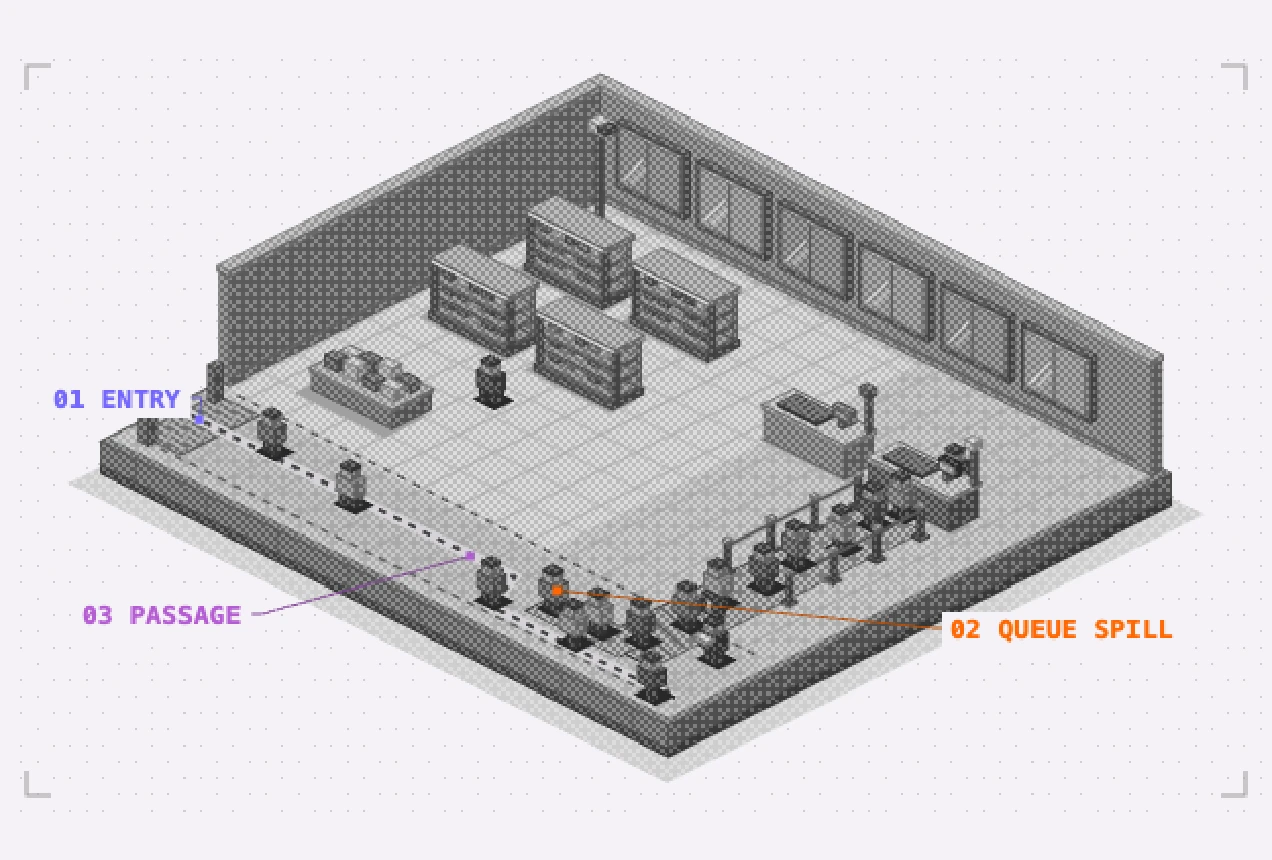
Ordinary concourse flow: the checkout queue stays inside its zone and visitors move freely through the passage.
Preset scene key / Sample signals
01 Entry
Steady arrival flow
02 Checkout
Three people waiting
03 Passage
Through-route clear
Exploration prompts
Key questions to explore
These questions are prompts for exploration rather than a checklist of required features. Explore one or more, or propose another relevant approach within this problem statement.
01 /
What can movement, occupancy or waiting patterns reveal about visitor journeys and how spaces are used?
02 /
How can these insights inform decisions about space arrangements, operational responses or visitor guidance?
03 /
How can the solution demonstrate improved visitor flow, more effective use of space or a faster response to changing conditions?
An illustrative scenario
When a queue spills into the walkway
Imagine a mall concourse with a pop-up counter near an entrance. A short rush can look crowded without causing a problem. The operator needs to spot when the checkout queue starts to block the through-route and whether an intervention restores movement. The numbers below are invented for the walkthrough.
01
Observe flow
Start at the entrance and follow people past the checkout. The queue stays inside its zone, and visitors can still use the marked passage. Count arrivals, people waiting and people passing through as separate measures.
Example signal
A one-minute sample has 18 arrivals, three people waiting and no overlap with the passage.
Operator choice
Keep monitoring. Save this window as a comparison for the next interval.
02
Spot a queue
The checkout queue grows toward the entrance and crosses the through-route. Compare the outline of the queue with the passage boundary and see how long the overlap lasts.
Example signal
The example shows seven people waiting and a 20-second overlap with the passage.
Operator choice
Check the view and ask floor staff to confirm the obstruction before opening another lane. If the camera view is blocked, mark the estimate as uncertain.
03
Respond
The supervisor opens a staffed second lane. Arrivals split between counters, and the marked passage starts to clear. Follow both queues to see whether the blockage shifts toward the entrance.
Example signal
The passage is clear and two people are waiting at each counter. Recheck the entrance and both queues in the next interval.
Operator choice
Compare passage overlap and queue length before and after. Keep the second lane open only if movement improves without creating another bottleneck.
Design considerations
What a prototype could do
Illustrative ideas and evaluation checks to help your team scope a clear, demo-ready AI prototype for the EIP Hub finale.
Who uses it
A property operations supervisor looks at the alert and decides whether to send staff. A floor team confirms what they see on-site. The operator needs a zone, a reason for the alert, and an indication of how recent and reliable the estimate is.
Example inputs
Use a synthetic or anonymised clip, a simple floor plan and timestamped counts by zone streamed over 5G. A sample record might contain the 12:05–12:06 window, zone Checkout A, an estimated seven people waiting, 20 seconds of passage overlap and a recent frame timestamp.
Useful outputs
Show a floor plan with entry, queue and passage zones, a trend for queue length and a short alert explaining what changed. Keep an event history so an operator can compare conditions before and after opening the second lane.
What to measure
Hand-label a short sample and compare the estimated counts with the labels. Record missed and false queue alerts, time from obstruction to alert, and how long an operator takes to decide. Compare passage overlap before and after the intervention.
Test where the signal can mislead
A group stops to chat
Check whether a brief stationary group looks like a queue. Use its position and duration to decide whether to ask for a review.
The camera view is blocked
Mark the affected zone as uncertain and show when the last usable observation arrived. Show a missing count as unknown.
The second queue blocks the entrance
Check both the entrance and the passage after staff intervene. A shorter checkout queue can still leave a worse route for arrivals.
Sample demo sequence
Show ordinary flow
Start with people passing the checkout and label the entrance, queue and through-route.
Replay a queue spill
Show the timestamp, estimated queue size and the passage overlap that led to the alert.
Show the operator's action
Open the second lane in the example and compare what happens to both queues and the passage.
Replay one failure case
Show how the prototype flags uncertainty, and state what data it retains and why.
Official track brief
How might we use AI and 5G to generate actionable insights from visitor movement and activity patterns, improving customer flow, space utilisation and operational response?
 01 / Observe flow