How might we use AI and 5G to detect unsafe vehicle behaviour or traffic incidents and deliver timely, location-specific alerts that support safer vehicle movement and coordinated responses?
Unsafe vehicle behaviour and traffic incidents can put people at risk around building entrances, internal roads and transportation hubs. Speeding, wrong-way movement or vehicles obstructing critical access may go unnoticed until an incident escalates. Site security and traffic teams need timely information to recognise the situation and determine an appropriate response.
The challenge is to detect a selected vehicle-related safety issue and turn vehicle and traffic information into actionable incident alerts. Clear information about the location, circumstances and supporting evidence can help teams verify incidents, prioritise action and maintain safe access.
Scene 02 / Illustrative simulationISOMETRIC · 3 STAGES
01 / Monitor access
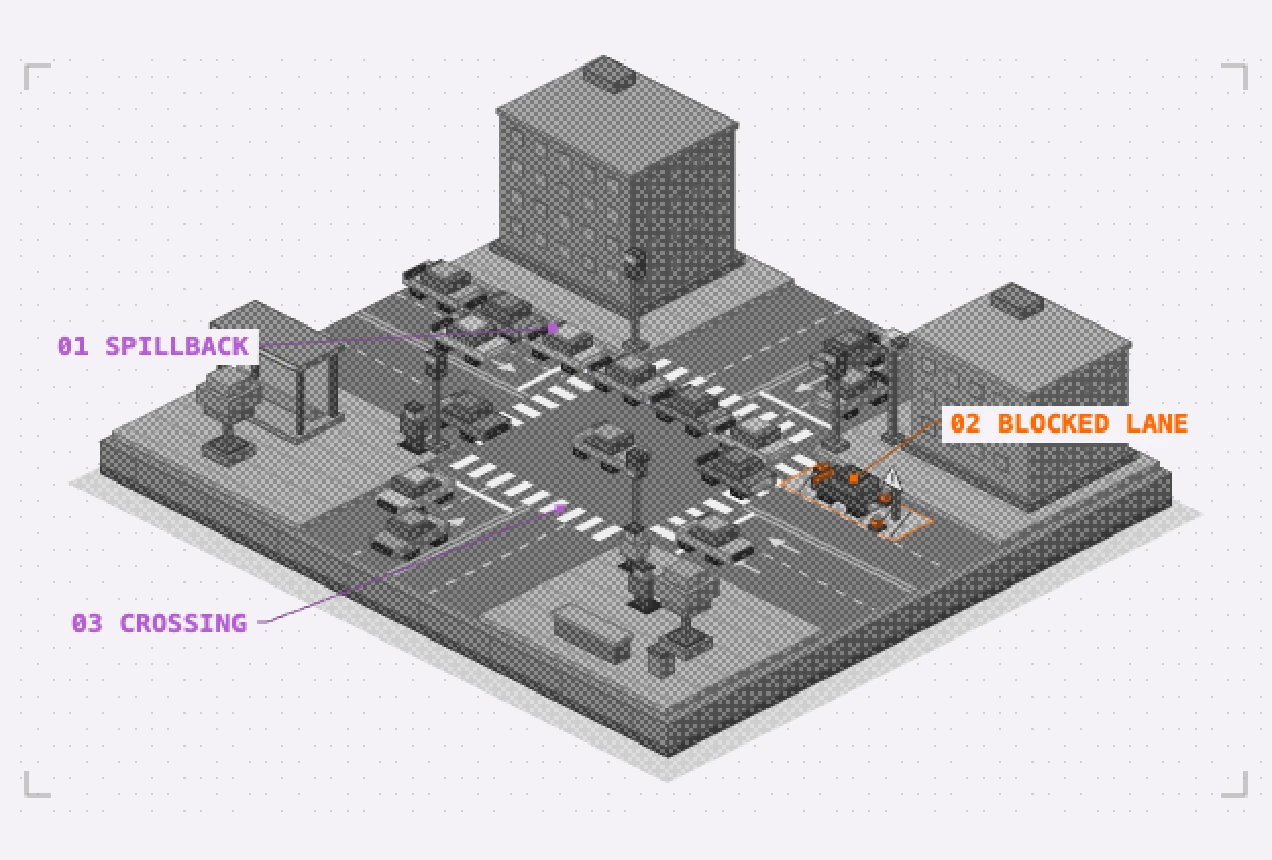
Normal junction traffic: speeds hold steady across the approach and pedestrian crossings stay clear.
Scene key / Sample signals
01 Approach
31 km/h in the sample window
02 Junction
All lanes available
03 Crossing
Crossing stays clear
Exploration prompts
Key questions to explore
These questions are prompts for exploration rather than a checklist of required features. Explore one or more, or propose another relevant approach within this problem statement.
01 /
How can a selected safety issue, such as speeding, wrong-way movement or obstructed access, be detected using relevant data?
02 /
How can genuine safety concerns be distinguished from normal conditions while minimising false alarms?
03 /
What information would security or traffic teams need to verify an incident, assess its urgency and coordinate an appropriate response?
An illustrative scenario
When a junction loses a lane
Imagine a stalled vehicle obstructing critical access near a busy building entrance or junction. Speeds drop on one approach and a queue starts to grow. The team needs to distinguish a genuine safety hazard from an ordinary slowdown, verify the evidence, and coordinate a safe response.
01
Monitor access
Watch the approaches, entrances and crossings as vehicles pass through. Compare speeds and queues across normal signal cycles to distinguish routine congestion from a safety incident.
Example signal
The sample approach averages 31 km/h, lanes are clear and queues clear after each signal cycle.
Operator choice
Keep the reference baseline and verify sensor timestamps before flagging a slowdown.
02
Detect incident
A vehicle stops in a critical lane or drives the wrong way, putting pedestrians and emergency access at risk. Supporting evidence and timestamps let the team confirm the alert quickly.
Example signal
Speed drops to 9 km/h with six queued vehicles and an obstructed access lane confirmed in a 5G edge snapshot.
Operator choice
Raise a location-specific alert with supporting evidence and urgency level for security and traffic teams.
03
Coordinate response
Security and traffic teams redirect approaching vehicles before the blocked zone while keeping pedestrian crossings and emergency access clear.
Example signal
Location, snapshot evidence and suggested diversion are shared with ground marshals in real time.
Operator choice
Confirm clearance on-site, update the incident timeline and reopen the lane once safe.
Design considerations
What a prototype could do
Illustrative ideas and evaluation checks to help your team scope a clear, demo-ready AI prototype for the EIP Hub finale.
Who uses it
Site security and traffic teams monitor entrances, internal roads and transit hubs. They need clear location context, supporting evidence and urgency so they can verify genuine risks and act quickly.
Example inputs
Use synthetic speeds, vehicle trajectories, access-zone boundaries and timestamped camera or roadside sensor events delivered over low-latency 5G links.
Useful outputs
Show an incident timeline and site map, location-specific alerts with supporting evidence clips or telemetry, and clear escalation options for ground teams.
What to measure
Measure detection latency, false-alarm rate during ordinary congestion, and how clearly the evidence helps an operator verify urgency and coordinate a response.
Test where the signal can mislead
A red light or drop-off creates a brief pause
Compare consecutive cycles and dwell duration so routine drop-offs or signal waits do not trigger false incident alarms.
One report is stale or conflicts with a sensor
Show the age of each input, mark unverified detections clearly and request human confirmation before issuing an advisory.
Rerouting shifts risk to a pedestrian crossing
Check downstream capacity and emergency or pedestrian access before recommending an alternate route.
Sample demo sequence
Show normal movement
Start with baseline vehicle flow across the monitored entrance, internal road or junction.
Trigger a safety event
Replay speeding, wrong-way movement or obstructed access and show the supporting evidence.
Verify & coordinate
Demonstrate how security or traffic staff inspect urgency and dispatch a coordinated response.
Test a false-alarm guard
Replay routine congestion or a stale signal and show how your prototype avoids crying wolf.
Official track brief
How might we use AI and 5G to detect unsafe vehicle behaviour or traffic incidents and deliver timely, location-specific alerts that support safer vehicle movement and coordinated responses?
 01 / Monitor access