How might we use AI and 5G to track goods or shared assets in real time, using movement and usage patterns to anticipate shortages and guide replenishment, allocation or redistribution?
Goods and shared movable assets regularly move between locations within buildings and facilities. Limited visibility of their location and movement can result in misplaced items, time-consuming searches, shortages and inefficient use of resources.
The challenge is to track a selected category of goods or shared assets within a defined building or site. Timely insights into location, movement and usage should help teams locate items efficiently, anticipate shortages and make better replenishment or redistribution decisions.
Goods and supplies: Medical supplies transferred between hospital departments, retail stock replenished from storerooms, and parcels moving through sorting and dispatch areas.
Shared movable assets: Wheelchairs, shopping or baggage trolleys, and delivery carts used across different departments or service areas.
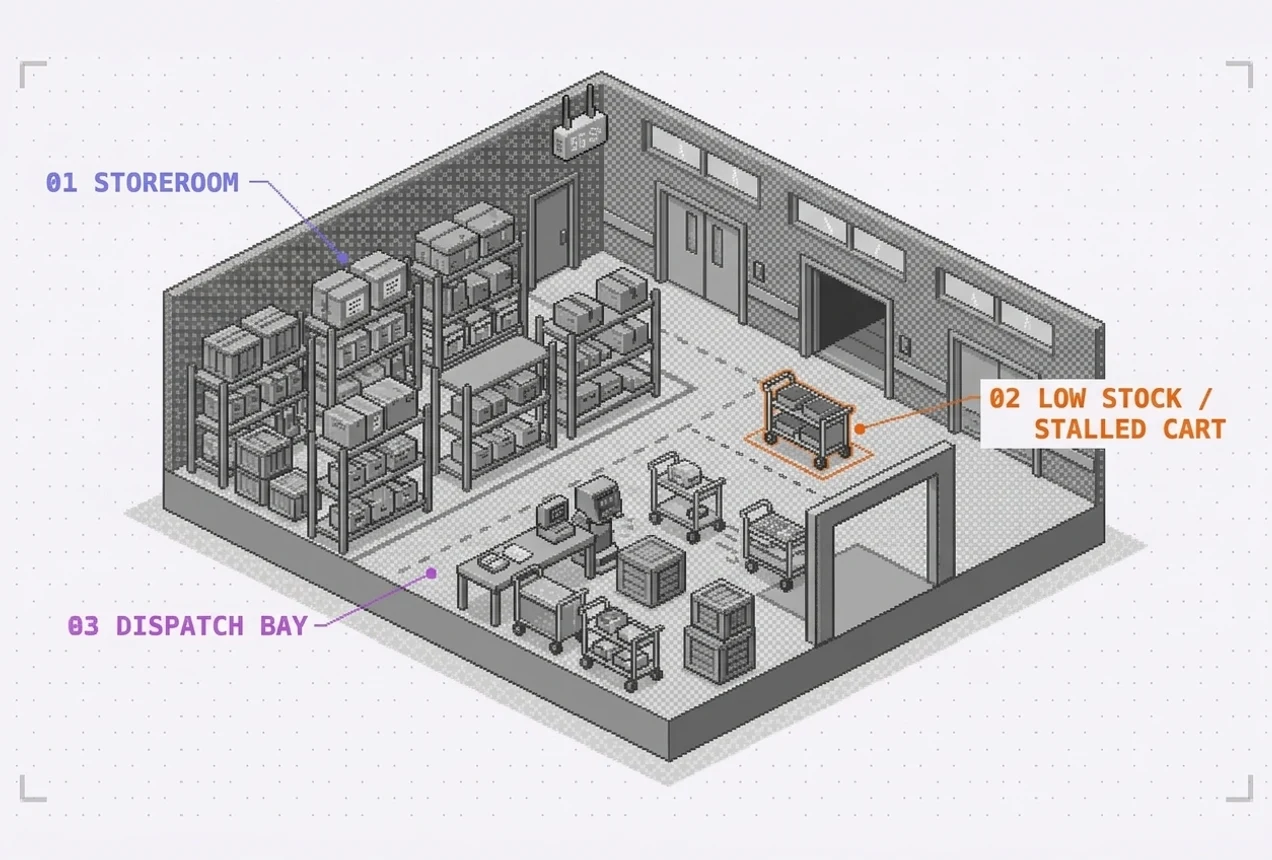
Scene 03 / Illustrative simulationISOMETRIC · 3 STAGES
01 / Map locations
Steady facility circulation: goods and shared carts are accounted for across the storeroom, corridor and dispatch bay.
Scene key / Sample signals
01 Storeroom
Stock within par levels
02 Corridor
Active transfer on schedule
03 Dispatch bay
Turnaround under 8 min
Exploration prompts
Key questions to explore
These questions are prompts for exploration rather than a checklist of required features. Explore one or more, or propose another relevant approach within this problem statement.
01 /
How can teams maintain an accurate view of where goods or shared assets are located and how they move between locations?
02 /
How can movement, stock or usage patterns reveal missing items, unexpected delays, potential shortages or underused resources?
03 /
How can these insights support timely replenishment or redistribution, improve resource utilisation and reduce losses or waste?
An illustrative scenario
When shared carts cluster and stock runs low
Imagine a busy hospital wing or retail facility where medical carts or replenishment trolleys move continuously between storerooms, corridors and service zones. Without real-time visibility, staff lose time searching while one ward runs dry and another holds idle carts.
01
Map locations
Track each asset or batch as it checks out of the storeroom, passes through corridors and arrives at its target department or bay.
Example signal
14 of 15 carts reported within the last 60 seconds via 5G indoor gateways; all zones above minimum threshold.
Operator choice
Maintain normal replenishment cadence and record baseline usage curves by hour.
02
Spot shortage & delay
Usage spikes in one zone while a transfer stalls en route. AI compares live drain rates against asset positions to warn of an upcoming shortage before teams run out.
Example signal
Ward B consumption is 1.8x normal while 3 idle carts sit in Wing C for over 20 minutes.
Operator choice
Verify the stalled cart location and trigger a targeted replenishment or redistribution task.
03
Rebalance & replenish
A runner receives a concise mobile prompt over 5G showing the nearest idle assets and priority drop-off zone, restoring balance without over-ordering.
Example signal
Search time drops and stockout is avoided; idle asset ratio falls across all zones.
Operator choice
Log task completion and compare search time, shortage frequency and waste before and after.
Design considerations
What a prototype could do
Illustrative ideas and evaluation checks to help your team scope a clear, demo-ready AI prototype for the EIP Hub finale.
Who uses it
Operations coordinators, stockroom supervisors and mobile floor staff who need instant visibility into where items are, what is delayed and where shortages are forming.
Example inputs
Simulated zone check-ins, RFID/QR/vision sightings, transfer logs and consumption counts synced in real time over 5G across floors or buildings.
Useful outputs
A zone-by-zone inventory and asset map, dwell-time and missing-item flags, shortage forecasts and prioritised replenishment or redistribution actions.
What to measure
Measure item search time, stockout lead time, idle-asset utilisation and reduction in expired, lost or over-ordered supplies.
Test where the signal can mislead
A tag is briefly occluded inside a lift or metal rack
Show last-seen zone and timestamp instead of falsely marking an item as stolen or lost after one missed scan.
Scheduled bulk transfer looks like a sudden drain
Distinguish planned restock runs from unexpected consumption spikes using shift or schedule context.
Redistribution empties another busy zone
Check each donor zone's forecast demand before pulling shared carts or stock away from it.
Sample demo sequence
Show the live facility view
Display tracked goods or shared assets across storeroom, transit corridors and service zones.
Replay a delay & demand spike
Show how AI spots a stalled cart or predicts an upcoming shortage before stock hits zero.
Trigger redistribution
Send a 5G mobile task to move underused assets or replenish stock and show zone balance recover.
Show sustainability & edge case
Highlight reduced waste or over-provisioning, plus how stale/missing scans are flagged cleanly.
Official track brief
How might we use AI and 5G to track goods or shared assets in real time, using movement and usage patterns to anticipate shortages and guide replenishment, allocation or redistribution?
 01 / Map locations