How might we use AI and 5G to detect early signs of equipment deterioration and generate actionable alerts that support preventive maintenance and minimise service disruptions?
Reliable building operations depend on infrastructure and equipment such as lifts, escalators, pumps, cooling and electrical systems. Limited visibility of equipment condition can allow deterioration to go unnoticed, resulting in unplanned downtime, service disruptions and costly repairs.
The challenge is to turn operating and condition data into timely maintenance insights and actionable alerts. By recognising early signs of deterioration and highlighting maintenance priorities, solutions can help teams strengthen preventive maintenance and maintain reliable building services.
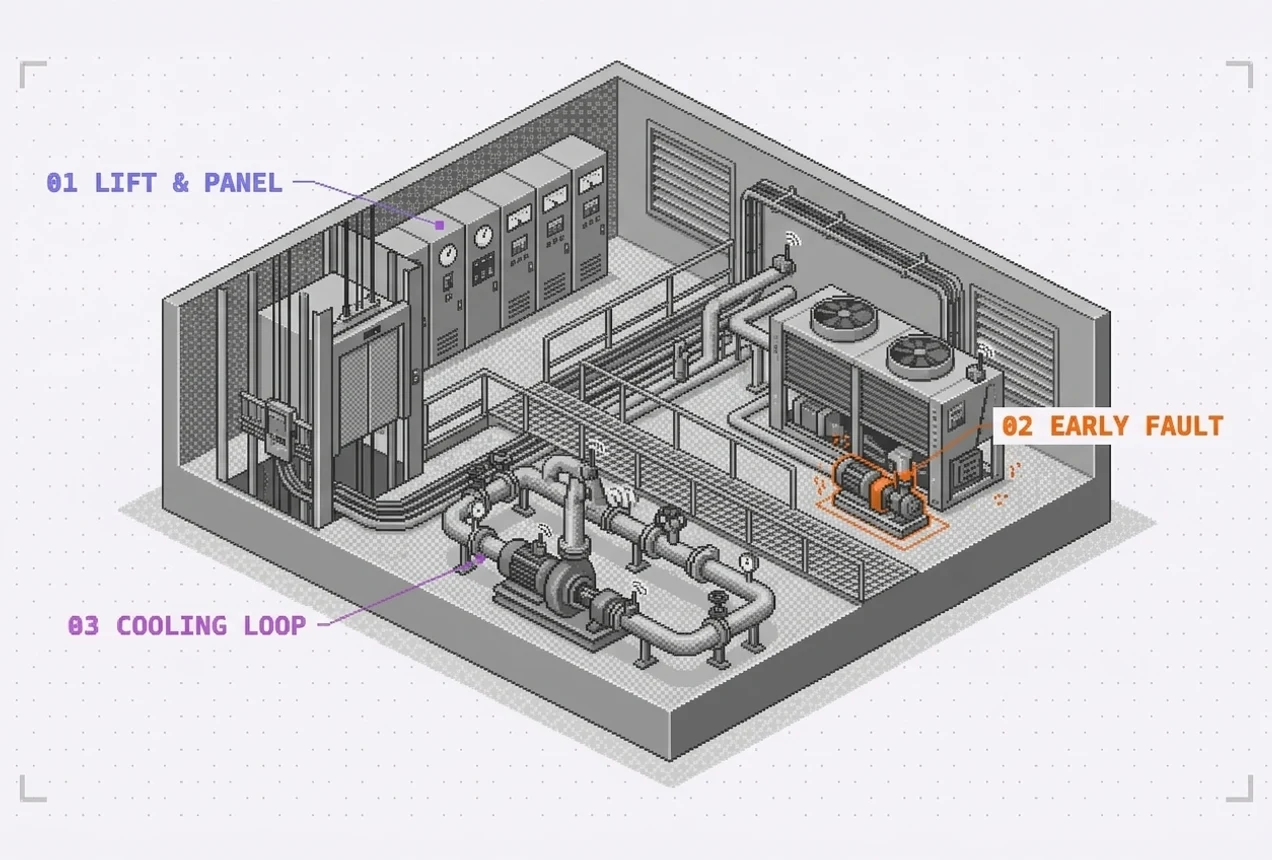
Scene 04 / Illustrative simulationISOMETRIC · 3 STAGES
01 / Monitor condition
Healthy plant room baseline: lift cycles, electrical load and cooling loop telemetry stay within normal operating envelopes.
Scene key / Sample signals
01 Lift & panel
Normal load & cycle time
02 Chiller unit
Vibration & temp nominal
03 Cooling loop
Steady flow & pressure
Exploration prompts
Key questions to explore
These questions are prompts for exploration rather than a checklist of required features. Explore one or more, or propose another relevant approach within this problem statement.
01 /
Which operating patterns or changes in equipment condition could indicate deterioration or a developing fault?
02 /
How can early warning signs be distinguished from normal operating variations?
03 /
How can alerts and maintenance insights help teams prioritise interventions before faults escalate into service disruptions?
An illustrative scenario
When a chiller pump begins to drift
Imagine a commercial building plant room where cooling chillers, water pumps, lifts and switchgear run continuously. A bearing begins to wear days before failure, raising vibration and energy draw subtly. Catching the drift early prevents a midday cooling outage and wasted energy.
01
Monitor condition
Stream continuous condition telemetry from lifts, pumps, chillers and panels over 5G IoT nodes, establishing normal load-adjusted operating bands.
Example signal
Chiller Pump 02 draws 18.4 kW at 42 °C with vibration at 1.9 mm/s, matching midday load baseline.
Operator choice
Record healthy reference windows across peak and off-peak building occupancy.
02
Spot early fault
AI separates sustained bearing wear from brief midday load spikes, surfacing an early-deterioration warning with the exact sensors that drifted.
Example signal
Sustained 3-day vibration trend + 14% excess power draw per cooling tonne; predicted failure window within 5–7 days.
Operator choice
Schedule a targeted inspection during off-peak hours instead of waiting for an emergency shutdown.
03
Prioritise maintenance
Technicians receive the diagnostic trace on mobile over 5G, inspect and replace the worn seal off-peak, and verify that telemetry returns to baseline.
Example signal
Post-service vibration returns to 1.8 mm/s and chiller power draw drops back to baseline.
Operator choice
Close the preventive work order and track avoided downtime and energy savings.
Design considerations
What a prototype could do
Illustrative ideas and evaluation checks to help your team scope a clear, demo-ready AI prototype for the EIP Hub finale.
Who uses it
Building engineers and maintenance teams managing lifts, escalators, pumps, HVAC chillers and electrical systems who need clear, ranked priorities rather than noisy threshold alarms.
Example inputs
Time-series vibration, temperature, pressure, motor current, lift door-cycle counts and service logs transmitted from retrofitted 5G IoT sensors.
Useful outputs
Asset health timelines, load-adjusted anomaly explanations, remaining-useful-life or urgency rankings, and concise technician work-order summaries.
What to measure
Measure lead time before failure, false-alarm rate during normal peak loads, avoided unplanned downtime and energy saved by fixing degrading equipment early.
Test where the signal can mislead
Afternoon heatwave raises normal chiller load
Condition thresholds on ambient temperature and occupancy so routine peak load is not flagged as a mechanical fault.
Startup surge spikes motor current briefly
Ignore expected transient startup curves and require sustained drift across multiple operating cycles.
A sensor disconnects or sends flatline values
Distinguish sensor health faults from equipment faults so technicians do not disassemble healthy machinery.
Sample demo sequence
Show healthy asset baselines
Present normal telemetry for lifts, cooling chillers, pumps or electrical panels across load changes.
Replay gradual deterioration
Walk through multi-signal drift and show how AI distinguishes early wear from normal peak variation.
Prioritise the work order
Show the ranked maintenance queue with failure urgency, tenant impact and supporting evidence.
Highlight energy & uptime gains
Quantify avoided disruption and lower energy waste, plus how a bad sensor reading is handled safely.
Official track brief
How might we use AI and 5G to detect early signs of equipment deterioration and generate actionable alerts that support preventive maintenance and minimise service disruptions?
 01 / Monitor condition